Pages

Friday, February 26, 2016

Facebook reactions

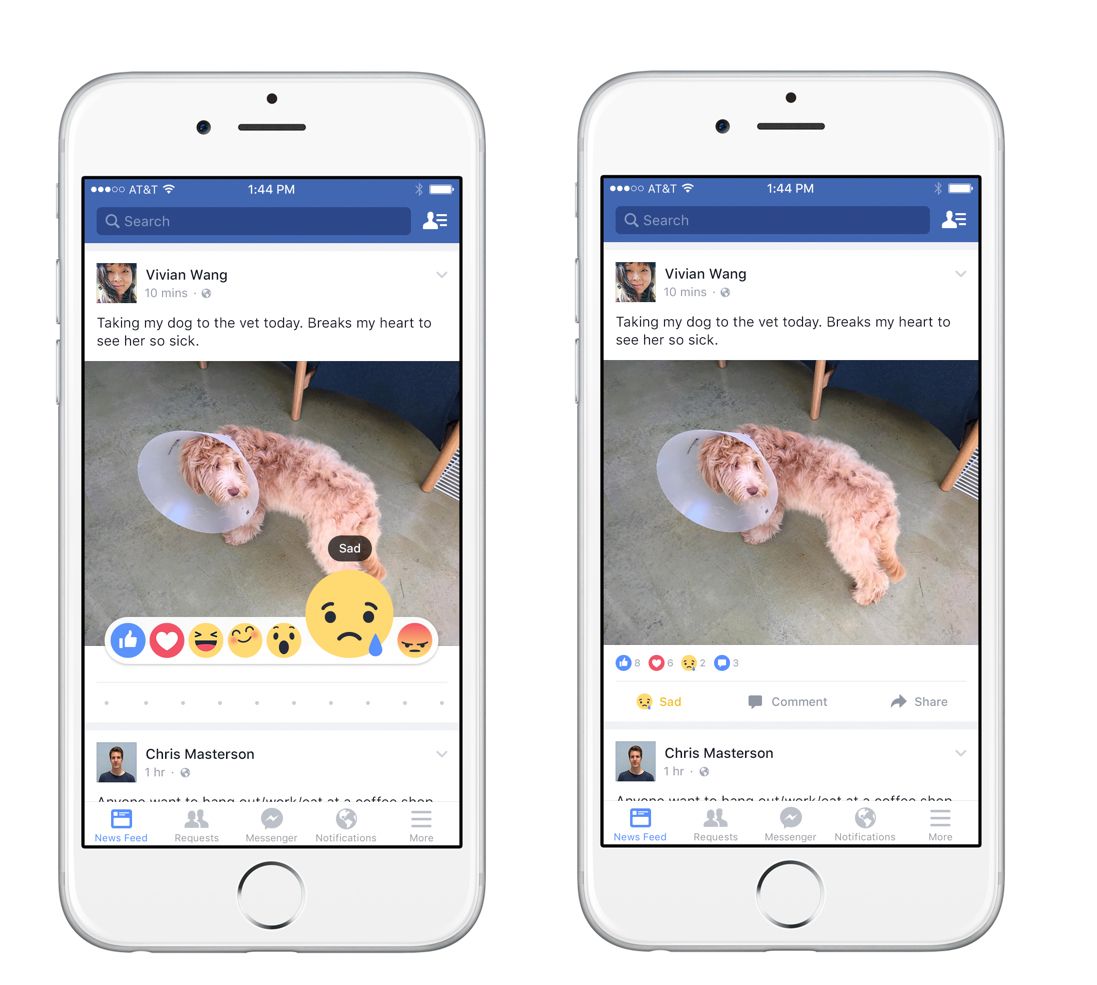
The new Facebook reactions are finally here.which means you can respond to someone's status with Love, Haha, Wow, Sad and Angry in addition to the familiar, original Like..If you're not seeing those options in your News Feed yet, though, we're here to help.
On desktop
On the browser version of Facebook, simply just hover over the Like button, and the new reactions will pop up in a bar above. Just be careful; it's very easy to accidentally "wow" or "love" someone's status inadvertently when you mouse over the new options

On mobile
In the Facebook mobile app, you might need to close the app completely and reopen it before the reactions appear. Once you hit the Like button on a post, a message will appear that instructs you to hold down on that button to bring up the other reactions. So don't be dismayed if you don't see the new reactions immediately.


.

Friday, February 19, 2016

Google Map-Marker icon

  Google Map embedded in Google Search that has a bunch of markers/icons but one of them is the letter P.I asked a bunch of local SEO experts what the letter P symbolizes and so far,Google has used different types of icons in their maps but it seems no one knows what the P is for. They've used H for hospitals, they've tried promotion/sponsored icons, they've used images and different colors.A marker identifies a location on a map. By default, a marker uses a standard image. Markers can display custom images, in which case they are usually referred to as "icons." Markers and icons are objects of type Marker. You can set a custom icon within the marker's constructor, or by calling setIcon() on the marker. See more about customizing the marker image below


Broadly speaking, markers are a type of overlay. For information on other types of overlay.
Markers are designed to be interactive. For example, by default they receive 'click' events, so you can add an event listener to bring up an infowindow displaying custom information. You can allow users to move a marker on the map by setting the marker's draggable property to true. For more information about draggable markers.

Friday, February 12, 2016

ASO- App Store Optimization

  According to Forrester, 63% of apps are discovered through app store searches. This makes search, in the app store, the most used method for discovering and downloading new apps. Recently, at Google I/O, Ankit Jain reported that “For the average app, search actually makes up the vast majority of installs.” Simply put, this means that:If you’re not using ASO to increase your app’s search ranking, you’re missing out on the largest discovery channel available to your app.With hundreds of thousands of apps in each app store vying to rank above one another, the amazing reality is that the majority of publishers are not investing in app store optimization. So here’s our gift to you: ASO is your secret weapon. Spend time every week improving your ASO, and you will meaningfully impact your app’s ranking and overall success.


With hundreds of thousands of apps in each app store vying to rank above one another, the amazing reality is that the majority of publishers are not investing in app store optimization. So here’s our gift to you: ASO is your secret weapon. Spend time every week improving your ASO, and you will meaningfully impact your app’s ranking and overall success.

App store optimization marketers, such as SEO marketers, work by optimizing their content so the search engine position it higher on the search engine results page, driving more traffic to this content. While making their content achieve the first position on targeted search terms can sum their objectives, it's not required to evaluate the optimization's success. ASO marketers try to achieve goals such as:

Being found more easily by users on the app stores, due to the fact that App Store Search is the No. 1 source for people to discover new applications
Rank higher compared to competitors
Rank higher for specific keywords
Rank higher in Google´s semantic search for applications
Create appealing graphics (icon, screenshots and promo video) to increase the chances of being downloaded

Friday, February 5, 2016

The Anatomy of True SEO ROI

Return on Investment:
         ROI is what every client wants from a search marketing agency. It’s an easy thing to calculate if you’re doing Pay-Per-Click (PPC) advertising. If your revenue is higher than your spend, PPC management fees and cost of goods, then your client is getting a return on their investment. Although it’s simple to figure out ROI for PPC, the same cannot be said for search engine optimization (SEO).
The Anatomy of True SEO ROI
True SEO ROI involves driving targeted traffic from SERPs, regardless of how long or short the keyword tail is. It also includes targeted referral traffic. Targeted traffic means traffic that accomplishes the purpose and goals of the website. That could be any of the following:
· Subscriptions
· Repeat Traffic
· Community Involvement
· Registrations
· Newsletter Signups
· Purchases
What’s tricky about reporting SEO ROI is that you have to connect the links that have been built with referral traffic from websites and search engines, and then connect that data with conversion results. Although Google Analytics can help connect the dots, it’s still difficult to sync, analyze and report on that data. This is something that Raven has spent a great deal of time on — creating a relationship between Link Manager data, Analytics and our conversion tracking code. The result is what we call true SEO ROI.
True SEO ROI can show you the effectiveness of any SEOcampaign. For example, if a campaign is focused on building links in forums that link to widgets on the client’s online store, then an SEO ROI report would show the success of that campaign. That report might include a list of inbound links that resulted in purchases, including details from related organic search engine traffic (matching or similar keywords used in the anchor text or within the context of the pages the links were built on) that resulted in purchases.
Each SEO ROI report should focus on and report the following key elements:
Conversions related to the campaign
Overall increase in conversions over time
Conversions related to search engine traffic
Overall increase in search engine traffic
Overall increase in unique users and traffic


Friday, January 22, 2016

Known facts on SEO

SEO is an ever-changing industry . Some of the necessary rules for SEO work are:

1. Web Design – Producing a visually attractive page.
2. HTML coding – Developing search engine-friendly coding that sits behind the web design.
3. Copy writing – Producing the actual readable text on the page.
4. Marketing – What are the actual searches that are being used, what key words actually get more business for your company?
5. An eye for detail — Even the smallest errors can stop spiderbots visiting your site.
6. Patience — There is a time lag on any change you make, waiting is a virtue.
7. IT skills — An appreciation of how search engine programs and the algorithms actually work.


Before worrying about bringing people to your site, you need to get the spiderbots to like your site. Spiderbots are pieces of software used by the search engine companies to crawl the Internet looking at all the websites, and then having reviewed the sites, they use complex algorithms to rank the sites. Optimizing a website to be Google-friendly is often a compromise between a visually attractive site and an easy-to-find site. The second skill is that of optimizing the actual HTML code to be spiderbot-friendly. Thirdly, I suggested that copy writing is a skill in its own right. This is the writing of the actual text that people coming to your site will read. The Googlebot and other spiderbots love text – but only when written well in properly constructed English. Some people try to stuff their site with keywords, while others put white writing on white space (so spiderbots can see it but humans cannot).
The fourth skill is marketing. After all, this is what we are doing – marketing you site and hence company and products/services on the Web. The key here is to set the site up to be accessible to the searches that will provide most business to you. Some people seem to want to make daily changes and then think they can track the web page ranking results the next day. Unfortunately, it can take a week for absolutely correct changes to take effect, in which time you have made six other changes. Add to this Google’s reticence to allow new sites straight on to its listings by adding a waiting factor of, maybe, three months for new sites, and you have a totally uncontrollable situation.
 The final and seventh skill is an appreciation of how search engines and algorithms work, for this where both IT and math experience is useful. People who have programmed at a detailed systems level have a natural feeling for how spiderbots will read a page, what they will search for, what tables they will set up, what weightings they may give to different elements. All of this builds a picture of the database that will be created and how it will be accessed when a search is undertaken. Unfortunately, this skill is the most difficult one to learn because it relies on many years experience of systems programming. 

Tuesday, January 12, 2016

Tips on Metadata to boost up SEO Performance


Numbers can be utilised for their eye-catching properties to draw users in and grab their attention. As they tend to stand out against text, adding numerical values to your metadata – as a date, price, percentage or as part of a phrase – can make a big difference to your click-through rates.

A good example of how you can do this is by using promotions and offers, as they usually contain numerical data. 

A call-to-action is exactly what it says it is: a prompt to get the user to act in a certain way – usually to make a purchase. Without a call to action in your metadata, encouraging users to click through to your site can be hard, and you’re likely to lose out to competitors who have action-focused metadata. 
As a general rule, your call to action should contain a simple, focussed verb. The simplicity of this can be doubly beneficial, as not only can it significantly increase your click through rate (and all the bonuses that this can bring), but it won’t take up a lot of space.
Usually, a call to action will be structured in the following way, with adjustments made to your brand’s industry and product: VERB for RESULT

Here are a few examples: 
·         Buy Today For 20% Off
·         Shop Today For Free Next Day Delivery
Sometimes, however, the call to action doesn’t have to be explicitly focused on a result. Instead, the result is implied, as in these examples:
·         Speak To Us About Your Claim Today
·         Call Our Specialist Advisors Today
As with calls to action, if you don’t actively try and prompt users to interact with you and your product, you’re likely to fall by the wayside. Using focused, urgent copy instead of passive language can determine whether a user makes an immediate purchase or decides to leave it for another day. 
A good way to create a sense of urgency is by suggesting that the product or service you’re trying to sell is running out, and that waiting to purchase would likely mean the user ends up missing out. Using short timeframes or suggesting limited stock levels is a great way of implementing this.
One thing to remember however is to keep tabs on whether the copy and metadata is up-to-date – there’s no point prompting people to act quickly for a limited time offer if that offer still exists a month later. 
A few good examples of urgent language are:
·         Limited Stock Remaining
·         Register Before [Date] For A Free Gift 
·         Winter Sale Ends Soon

Friday, December 18, 2015

Mindset Segmentation


Organizations need tools for listening. #Mindset personas bring customers to life and enable employees to anticipate customers’ emotional needs.

While marketing segmentation distinguishes people according to their buying behaviors, mindset segmentation identifies people based on their emotional desires and expectations. These psychological personas or archetypes reveal how customers perceive a company’s brand; whether their values are reflected in the company’s values; and how the company’s products fulfill their personal needs for self-esteem or security. 


#Mindset segmentation illuminates the heart and mind of a customer. Communicators then craft messages that are rooted in understanding, as if derived from a personal conversation. It is a process of building rapport, which begins with listening; it is not a process of telling or showing.